Manager evidence and continuity v0
Design evolution: Capable Agent Manager and Semantic Work Handoff RFC (中文版) proposes the next product direction. This document retains the implemented baseline and compatibility contract until the RFC milestones are qualified; its restricted manager defaults are not silently changed by the proposal.
Status: staged implementation. The synchronous manager transport and read-only
goal-portfolio provider are implemented. Managed conversational turns now read
fresh scoped Core evidence. The shared cross-entry request ledger, optional
Decision Context adapter and complete three-goal acceptance remain unqualified;
this change does not claim those outcomes.
Ownership and defaults
Core retains authoritative Goal, Todo, gate, quota, evidence, and lifecycle state. The manager observes, explains, and coordinates that state. Decision Context, when explicitly enabled, combines verified evidence with background context to make advisory proposals. Neither consumer may store an editable second version of "real progress" or turn its own chat summary into evidence.
The built-in manager is a stable logical role, separate from a replaceable executor session. Frontend conversation and an addressed Lark message should receive a synchronous conversational response within their authorized scope. Long-running work is assigned to an exact worker with a durable return route. The initial receipt does not end the exchange: the worker evaluates or executes within its current authority and returns an audience-ready decision/result to the original conversation automatically. Acknowledgement or adoption does not remove the request from the receiver's hook; a committed conclusion does. The Chat runtime then owns transport recovery, separately from work completion.
The expected exchange is receipt → receiver assessment/work → conclusion. Meaningful intermediate feedback is optional and coalesced when a conclusion is already ready. Normal delegation requires neither a second confirmation nor a second status question. Failure, deferral and rejection are explicit results, not silent disappearance. A direction-setting request may conclude in a plan change; an execution request needs an execution result or explicit blocker.
The builtin manager-context capability owns this round trip; its Lark provider
reuses the existing Inbox reply/ACK path. Current Core Todos and deliveries own
work truth. Private decision reasoning is not automatically sent to a group;
the receiver supplies audience-ready reply text. The exact source grant and live
binding are checked again before transport, and a failed/unverified send never
means a successful user-visible return. See the capability README for the
receiver read/acknowledge/link/report workflow and recovery behavior.
Live activity labels follow the executor's typed event. Receiving a message, reasoning, producing an answer, and invoking a tool are different activities. An unknown item remains generic activity; item completion alone proves neither a Goal read nor a successful check. Do not expose item bodies or tool inputs in activity labels. Diagnose response latency using request acceptance, upstream turn start, first answer, and completion timestamps; a silent upstream interval does not identify a scheduler delay or prove what the executor was doing.
Reuse the existing global-manager protocol,
Decision Context source plane, and
periodic report lifecycle. The proposed Goal Portfolio
provider is a read model serving the existing manager outcome, not a new
capability merely to introduce a provider. Core owns typed state semantics;
presentation owns bounded collection and rendering. An optional
DecisionSourceProvider adapter can exact-read this same projection without
making Decision Context a prerequisite for basic manager reads.
Manager upgrades retain the existing connection identity, Topic and receipts.
Retiring an async inbox and saving its replacement form one compensated write
operation: hold the binding/source mutation locks, and restore the prior
binding, source registry and affected shared Goal if a write fails. Recovery
must verify those authorities before claiming the old route was preserved;
failed compensation returns upgrade_recovery_required. Shared-registry
recovery must retain concurrent updates to other Goals. This exception-recovery
contract does not claim crash-atomic persistence across multiple files.
Global conversation initialization
The owner manager uses the canonical loopx-manager identity and an isolated
runtime workspace. Session creation requires no Goal, and selecting a Goal
cannot change its workspace or evidence scope. Every conversational turn reads
the current authorized registry through goal-portfolio, freezes that snapshot
in a manager.context event, and supplies it to the executor. Chat prose is
never the inventory. Normal manager questions no longer silently use a limited
frontend projection; explicitly choosing status-only still uses that projection.
Manager defaults are gpt-6-astra with high reasoning. Set
LOOPX_MANAGER_MODEL and LOOPX_MANAGER_REASONING_EFFORT on the Chat service to
override them; an explicit override always wins. Thread start, resume and turn
start explicitly carry the settings; worker configuration is unchanged.
Capabilities expose the manager defaults and their source.
Steward channel host selection
The steward channel selects its executor; nothing discovers it. codex is
the shipped endpoint because it is the only transport that can hold an
interactive steward session today, and LOOPX_MANAGER_ENDPOINT re-points that
default. A configured operator credential (DEEPSEEK_API_KEY, endpoint in
DEEPSEEK_BASE_URL) is never a selection signal: discovering a provider key does
not move the steward channel onto that provider's executor, and it does not move
the channel's model either. The model follows the endpoint the operator selected,
so gpt-6-astra stays the default while the channel runs on the CLI endpoint. The
credential is reported as a fact -- the variable name, never the value -- and only
for the endpoint that actually authenticates with it.
The managed Turn host (dsh) runs one bounded work segment per request and has no
interactive Chat transport, so a session request that names it fails as the typed
managed_host_chat_transport_unsupported host-tool gate instead of an unknown
endpoint error, in both the Chat service and Lark routing. Promoting dsh to the
steward default is gated on that transport, not on a credential. The steward still
drives managed work on dsh: those bounded Turns are the managed execution
unit described by the LoopX Turn host selection contract, and they are separate
from the channel the steward answers on.
The Chat capabilities payload carries this resolution in its manager block
(channel_binding): the resolved executor endpoint and its source, its executor
kind in the same vocabulary as the governed Turn surface (individual runs on
one person's CLI login, managed on an operator credential), the resolved model
and its source, whether an operator credential is configured, and
available/unavailable_reason when LoopX can prove the selected endpoint cannot
serve this channel. available is null when the projection makes no claim. A
frontend can show which executor and model the steward channel resolved, and why,
without re-deriving the rule.
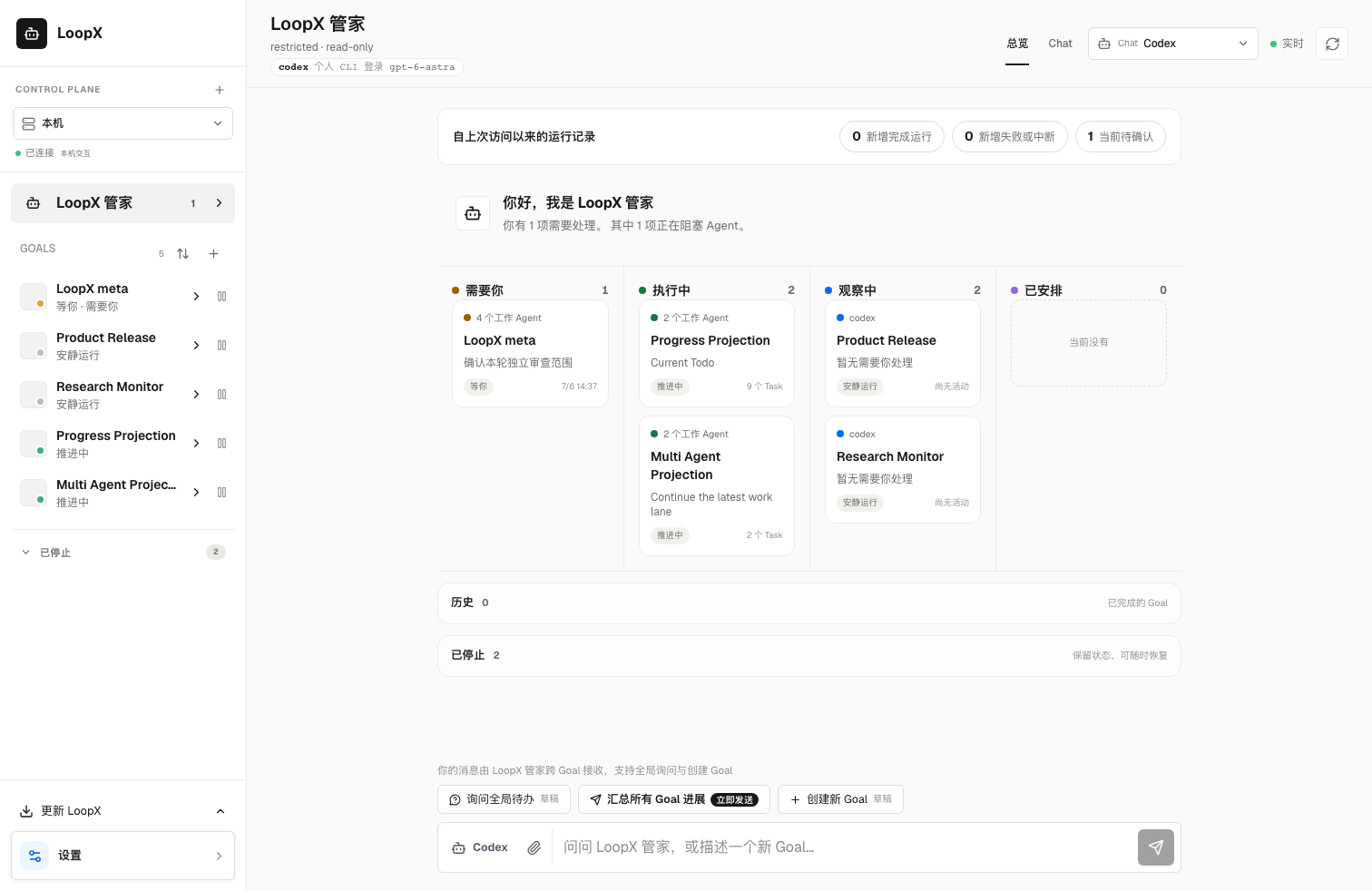
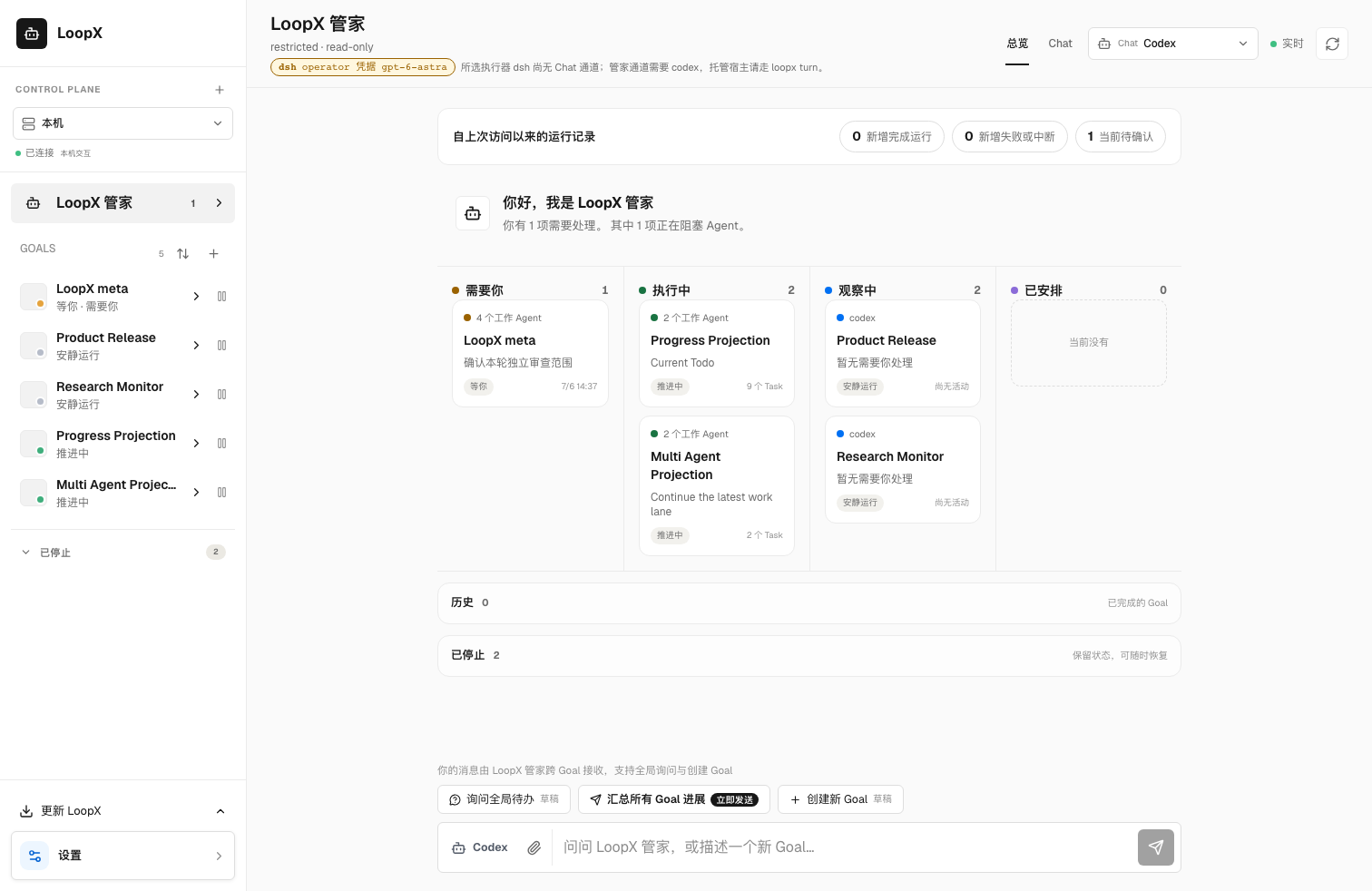
The Personal Workspace manager header renders that binding as one compact chip
(executor · executor kind · model). The chip is display-only: it reads the
projected fields, keeps the executor kind in the same individual/managed
vocabulary, and names an unrecognized kind as an unclaimed registered endpoint
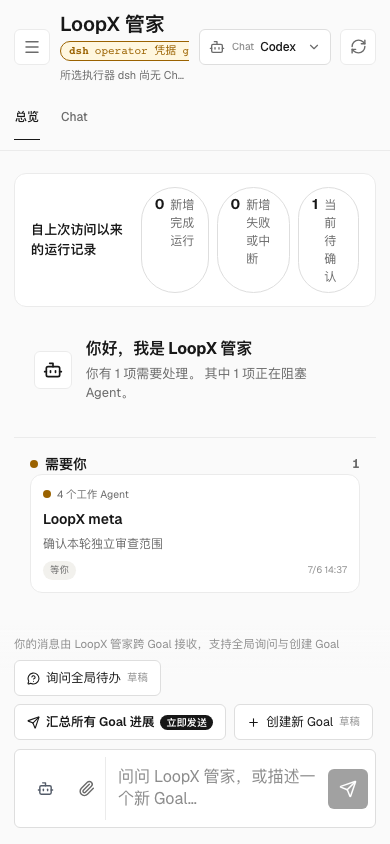
rather than guessing. When the projection proves the selected endpoint cannot
serve the channel, the chip is marked unavailable and the header states why in
the same row. A capabilities payload without channel_binding renders the
previous header unchanged.
| Surface, Chinese | Shipped selection | Managed host selected |
|---|---|---|
| Desktop, 1512px | Chip | Unavailable |
| Mobile, 390px | -- | Unavailable |
Legacy managed manager sessions retain their logical identity and bounded chat history but start a fresh executor thread in the same Codex home on first restore. This removes inherited project instructions without importing sessions across homes. Existing home-identity checks still apply.
External manager continuity is also bounded by the exact authorized Goal set. An empty, missing, or changing external authorization fails before the model is called. When the authorized Goal set changes, LoopX starts a fresh upstream thread without the previous model history before supplying the new scope. This prevents evidence learned under a former binding from crossing a later authorization boundary while retaining the owner-visible local receipt history.
Global means all Goals in the current owner's registry, including stale or unavailable entries; it does not claim discovery of unregistered remote hosts. External manager channels resolve their current authorized Goal scope through an injected control-plane resolver before collection and recheck it before handing evidence to the executor. The Lark adapter uses the active connection, exact audience, session, executor and connector identity. Missing, disabled or ambiguous grants produce no Goal evidence; a session's old Goal is not a grant. Changing/revoking scope during collection discards the collected snapshot. Global scope never means broadcasting private owner context to all Lark groups. A proposal without an exact Goal must not inherit the first visible Goal as a write target. The current Todo proposal schema requires entering a specific Goal for preview and apply.
Full-inventory reads reuse one Core status collection. Bounded or externally scoped reads select their Goal before collection. Inventory and source version changes during collection make evidence conflicting; missing sources remain unknown. Collection is capped at 128 Goals and eight agents per Goal, with explicit omissions. Recorded evidence references identify Core receipts, not independent artifact verification.
Each dated delivery now includes bounded recorded_details from the same Core
run index: the Agent's checkpoint explanation, observed reality, path outcome,
result class, probe kind and surface identity. Missing, malformed and truncated
fields are explicit. Evidence identifiers are hashed into stable lineage refs,
with included/omitted counts; they are not artifact access capabilities.
The manager should explain these concrete recorded findings and counterevidence,
joined to the task title, rather than return only receipt IDs and future plans.
These facts retain recorded_claim_not_independent_verification and
artifact_read_status=not_read. No repository, arbitrary path, URL or transcript
reader is added. Existing owner/external scope checks and snapshot identity
cover this hydration; there is no second progress store or extra history scan.
A bounded portfolio with explicit coverage
Discover Goals from the authorized registry inventory, including unavailable registered hosts. Do not infer inventory from recent chats, a limited dashboard list, or only Goals present in the attention queue. Bind every row to opaque host, project, Goal, registered Agent, and task references. Missing Agent/task identity is explicit unknown, never guessed from a display name.
For each discovered Goal, collect compact canonical status, typed Todo/gate projections, and evidence-backed delivery history. Existing global-todos and global-risks classification rules remain authoritative at their owning seam; the portfolio must not duplicate them in prose or an LLM prompt.
The proposed projection records:
| Component | Required meaning |
|---|---|
| Identity | Exact host/project/Goal identity and verified Agent/task relations |
| Provenance | Source reference, revision or digest, source observation time, collection time |
| Work | Recent verified deliveries and evidence refs, separately from accounting and liveness |
| Readiness | Typed runnable, awaiting acceptance, dependency blocked, or unknown; explicit source relation |
| Owner attention | Only verified owner actions/gates, with affected scope and why the Agent cannot proceed |
| Quality | Fresh, stale, conflicting, or unreadable facts; affected fields and reason |
| Coverage | Inventory source/revision, discovered, attempted, verified, omitted counts and omission reasons |
Coverage counts apply to the visible authorized inventory. Verification quality partitions discovered Goals into verified, stale, conflicting, unreadable, and uninspected categories; readiness is a separate axis. Pagination, time budgets, unreachable hosts, and permission restrictions remain visible. If discovery itself fails, the total is unknown, not zero. A verified empty inventory is distinct from a failed empty response. Hidden Goal identities are not revealed to an unauthorized audience merely to explain coverage.
A collection is not an atomic cross-host snapshot. Freeze its source revision vector and time window. If a source changes during collection, boundedly retry or mark the affected row inconsistent. Older evidence may remain visible with its timestamp but cannot prove current absence of progress. An unreadable or stale Goal must say "current progress unknown", not "no progress".
Progress selection uses typed delivery/evidence relations and stable outcome identities. Select material outcomes before applying the display limit; quota charges, wake-ups, polling, and report generation belong in supporting accounting. A newer quota event must not evict an older genuine delivery. Only a complete, fresh, bounded comparison may assert no new verified delivery within that observed window; it says nothing about work outside coverage.
One service, scoped continuity
The durable manager identity is independent of session process lifetime. Conversations bind an authorization scope, audience policy revision, and logical conversation ID. Default frontend private and external group scopes remain separate. Transport membership alone does not grant access to another Goal, personal financial context, or private company material.
Where an owner has explicitly established equivalent authorization scopes, both entrypoints may reference the same logical conversation, frozen evidence packet, request identity, and action receipt. "Synchronous" means a response in the active conversation and consistent authorized state; it does not mean mirroring all transcripts between groups. The current audience-hashed session foundation provides separation, not proof of this cross-entrypoint continuity.
Evidence selection and audience filtering occur before model context and rendering. Frontend and Lark views of the same snapshot and scope must agree on facts, evidence, coverage, and uncertainty; wording may differ. Different scopes may reveal different subsets and must not imply equal coverage. Caches are disposable derived views keyed by source revisions and audience policy, never lifecycle authorities.
Requests, authority, and recovery
Reuse Core typed preview/apply commands and existing connector receipts. Extend their owning boundary with a durable request envelope only where a real cross-entrypoint call site needs it. Its identity binds an origin request, logical conversation, verified requester/scope, exact target tuple, action, payload digest, authorization reference, and expected target revision.
Transport event identity deduplicates transport retries. Explicit forwarding or handoff carries the same origin request ID across entrypoints. Independently typed similar messages are not safely deduplicated by text or time heuristics; without shared identity, propose and confirm the intended action rather than guess that a second execution was authorized. Changed payload with a reused request ID is rejected. Recheck current scope and target revision before apply.
The action lifecycle distinguishes proposed, authorized, dispatched, confirmed, failed, and outcome-unknown. Persist the dispatch intent before its effect and bind the resulting receipt to the exact target. Replays return that receipt without reapplying. After a crash with an uncertain external effect, reconcile by provider idempotency/readback before retry; if the provider cannot prove the result, retain outcome-unknown. Do not promise universal exactly-once effects.
Default manager duties allow authorized reads and summaries; reminders use an existing authorized destination/subscription. Goal changes, steering, cross-Goal dispatch, pause/resume, publishing, and trading keep their existing operation-specific authority. A special role grants no extra permissions. No new confirmation is needed where a valid standing grant already covers the exact action. Missing grants or ambiguous targets never cause broadcast.
Periodic report persistence stays in periodic_report: freeze the evidence
snapshot and period, retain per-audience/sink delivery status, and commit the
publication cursor only after required delivery readback. Keep source scan,
decision review, report generation, and publication cursors distinct. A failed
optional sink does not erase a successful required-sink receipt. Restart resumes
pending delivery with the original report identity and reconciles uncertain
sends. Late-arriving material evidence remains eligible for the next report.
Five acceptance scenarios
Use three owner-authorized real Goals from different projects. Keep actual identities, source payloads, and receipts in ignored private qualification state; public fixtures use synthetic peers. Never corrupt a live Goal to simulate staleness or failures.
| Scenario | Required evidence |
|---|---|
| Ask what advanced today through both entrypoints | Same authorized frozen snapshot: matching material outcomes, evidence refs, coverage and uncertainty; exact channel readback |
| Material work followed by many accounting events | Real delivery retained after ranking and truncation; quota entries identified only as supporting accounting |
| One stale/unreadable Goal | Named authorized coverage gap and unknown current progress; no healthy/unchanged inference; controlled replay plus actual source observation |
| One authorized steering forwarded across entrypoints | One exact target transition; shared request ID and receipt; duplicate replay, wrong target, changed payload and revoked grant rejection |
| Restart after report dispatch | Resume from persisted per-sink receipt; no duplicate confirmed send; uncertain send reconciled; late major evidence included subsequently |
Mocks and transport tests support these checks but do not replace real source, session, routing, and delivery qualification. Keep each scenario pending until its evidence is recorded. Frontend/Lark equality is assessed only within the same authorized scope; denied content must never reach model context.
Delivery sequence and separate accounting
Host automations are generated by loopx heartbeat-prompt --thin. They bind
execution identity and wake the host; they do not contain domain priorities,
report calendars, source lists, strategy rules, or a private dispatch loop.
Goals and typed Todos own work and dependencies; capability profiles own
specialized behavior; providers and hooks execute their declared contracts.
The existing generator binds one Goal/Agent. A host allowing only one heartbeat
per conversation therefore needs a generic, explicit multi-Goal dispatch
contract before that one heartbeat can claim to drive a portfolio. Do not
silently drop a Goal, concatenate conflicting per-Goal lifecycle prompts, or
create a shadow scheduler to disguise the missing contract. Qualification must
prove authorized bindings, isolated quota/receipts, bounded selection and
fairness, and that one Goal's pause hint cannot stop other eligible work.
- Finish the synchronous manager/worker default and in-place connection migration foundation. Qualify installed session routing; do not label it complete portfolio or reporting support.
- Implement the bounded portfolio at the existing manager read boundary; prove coverage, evidence selection, freshness, and failure semantics first.
- Feed the frozen projection to frontend and Lark, and optionally the existing Decision Context source interface; verify scoped consistency.
- Close cross-entrypoint request identity and exact-target steering recovery through existing typed control contracts.
- Extend existing periodic report recovery and complete all five real-goal acceptance scenarios before claiming reduced operator attention.
Track domain research outcomes, manager attention reduction, and reusable product delivery separately, each with its own Goal, budget, evidence, and next action. One delivery spends once against its accountable Goal; another Goal may reference the evidence without claiming a second outcome. Protect a recurring domain-validation slot in the owner's plan. Infrastructure progress does not prove a research hypothesis or improve an investment result.
Current work details and default manager instructions
Each conversational turn also reads current Todo records through Core's
canonical-first list_goal_todos path for each authorized Goal. This read is
independent of the age of progress receipts. It retains bounded task titles,
owner gate/action distinctions, declared priority and target/dependency IDs;
owner conversations also receive bounded continuation notes. Terminal items
are excluded and active/included/omitted counts are explicit. Read failures
mean unknown, never an empty healthy queue. The evidence is a frozen projection,
not a second Todo store or a fresh claim that old tasks remain urgent.
The neutral manager workspace receives managed AGENTS.md instructions and the
same role contract is supplied to its executor. Custom owner instructions are
not overwritten. The default manager must connect concrete owner decisions to
affected work and explain its recommended order; bare Todo IDs, Goal ordering
and gate counts are insufficient prioritization evidence. It distinguishes
current declarations from verified execution and names unavailable/truncated
details. External audiences retain their existing Goal authorization boundary
and do not receive owner continuation notes. No repository browsing or write
permission is added to the manager model.
Intent delegation and worker-owned planning
The default manager interaction is intent delegation: the owner expresses an objective, new information or constraints; the manager routes the original message to an exact registered worker; that worker assesses its current Goal, evidence and commitments, decides whether to replan, and reports its decision. Todo editing is an internal planning operation, not a required user interaction. Ordinary authorized delegation does not require a second preview confirmation.
The built-in manager-context capability supplies a private durable inbox and
uses the existing turn-start hook contract. The Chat host, not model prose,
writes the original message and verifies its receipt. The model can select only
context_handoff={goal_id,agent_id} from the supplied recipient catalog; it
cannot supply replacement text, priority or Todo edits. Delivery does not
interrupt an active turn, change scheduling, or claim the worker finished.
The next existing worker turn reads pending context before choosing work; the
worker can adopt, defer, reject or retain its plan, recording a reason through
manager-inbox acknowledge. Delivery and decision are separate receipts.
Core remains the only authority for actual Goal/Todo/progress state.
Owner-local manager conversations use registered recipients by default. External manager channels require provider-recorded sender/source provenance plus an exact sender/recipient grant in private runtime configuration. Recipient routing does not expand the channel's Goal evidence read scope. Revocation is rechecked at delivery. See manager context configuration. Missing or ambiguous targets require resolution, not an invented recipient. Trading, payments, publishing and other protected operations retain their own authority requirements; forwarding context supplies no additional authority.
Requests are idempotent by original source identity and exact recipient, never by text similarity. Different independent frontend and Lark requests remain different requests: this implementation does not claim automatic cross-entry origin correlation. A delivered request remains deduplicated after worker acknowledgment and service restart. Full three-Goal live acceptance remains open.
Lark receipt feedback
After a routed manager message is durably captured, the synchronous ingress
uses the existing inbox reaction ledger to add the configured received emoji
(default Get) before waiting for the model. Replayed source messages reuse the
same receipt. Emoji failure is diagnostic and does not suppress the answer;
verified final reply performs the existing reaction cleanup and message ACK.
This received indicator is distinct from internal processed-message ACK and
from downstream work completion. Provider sender identity is preserved through
canonical event conversion into the manager handoff provenance record.
Listener registration alone cannot prove upstream message delivery. If provider history contains an addressed message but the bus received count stays zero, record that gap explicitly; do not report a missing event as successful intake.